
The Four Forces: Guideposts for Creating an Intentional Future
Perspective is powerful. Change is always present, so our ability to see it gives us the capacity to ride it. And that perspective, when you're riding it, ensures the kinds of returns you need most: relevance, resilience, and revenue.
Developing Strategy for a Turbulent World
CEOs and boards of directors want to know: How should we respond to emerging threats and new types of competitors? Where do we grow next? In a rapidly changing business environment, these questions have no “correct” answer—and it’s no longer possible to answer them using traditional tools like straightforward market analysis. But if we zoom out far enough to see our place in history, we can also see our place in the future. And that’s where the Four Forces come to our aid.
The Four Forces are a strategic Foresight tool that helps us scope research related to a visioning, strategy, or innovation process. All current issues and trends have their roots in these Four Forces, as do all the future potentials that deserve our attention. The Forces tell us:
Where we should be looking to understand an issue or opportunity more fully
How to challenge our cultural assumptions and biases
Where we’re likely to uncover important perspectives and opportunities
The Four Forces is a tool for asking and watching where trends come from. As much as humans can be drawn to trends, they don’t get to the nature of our opportunities, they’re too near-term. When you chase trends, we’re often proceeding with blinders on, accepting things at face value without our own investigation. The Four Forces tell us how trends will be unfolding such that we can anticipate them and create the future we want to create.
When we use this sense-making tool, we generate insights that are universal yet specific, original yet practical. And get some super-smart benefits. You’ll know which trends will have the greatest impact on your organization, you’ll be able to better anticipate your customers’ needs, and then make shifts to your business model as needed to build out innovations that sharpen your advantage into the future.
Change Is Predictable, Outcomes Are Not
In order for a society to perform well it has to ask and to answer four critical questions. In a way, we are always evaluating those questions and looking to understand what's emerging in the places.
What do we have to sustain our lives?
What can we make to improve our lives?
Who’s going to help us do the work and allow us to grow strong?
How do we organize our lives, work in common purpose, and share our burdens and successes?
The Four Forces effectively identify the social manifestations of these questions: resources, technology, demographics, and governance. Stepping back and examining these Force Fields is helpful because uncertainty and opportunity don't just reside in industry categories or certain geographic locales—they cross disciplines and sectors. Therefore, we can do our best work, find our steadiest path, and spot our likeliest potentials by understanding that our world--and human society—is driven by these forces. They give us a bold perspective.
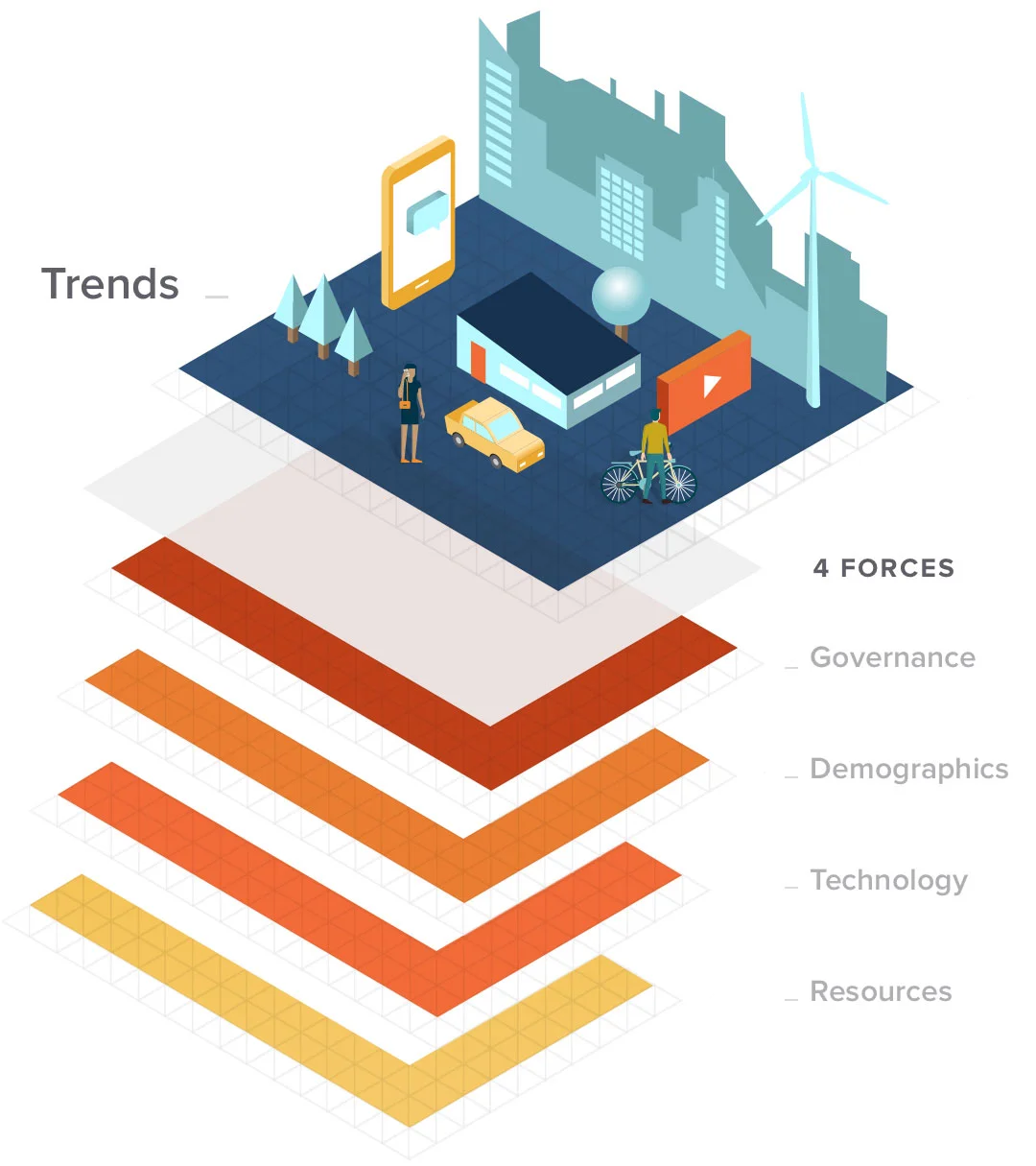
1. resources
This is the first of the Four Forces because resources are the foundational
elements we rely on to stay alive and prosper. These include the raw materials
in our environment: land, water, energy. As resources shift, we react; as resources deplete or grow, we adjust.
3. demographics
To be strong, a society must have demographics that allow for procreation and effective labor. Societies need groups of people that can continue to build and develop the world around them. Sex, ages, talents, ethnicity, and skills all impact our stability. When demographics shift, economics, workforces, and family structures all shift, too.
2. technology
Over time, humans have invented an exceptional number of tools to harvest resources and take exponential advantage of the world around us. Technology encompasses the tools we use to extract value from the raw materials around us and create new products. For example, we figured out how to tie vines together to create a net to capture many fish rather than use a stick to get only one.
4. governance
Governance shapes how people, organizations, and groups interact and behave. It can be a powerful force in driving the ways we understand ourselves and each other. Ultimately, it’s the set of rules that manage how people use the other three forces: resources, develop technology, and collaborate.
The Four Forces help us gain perspective: they allow us to see a bigger picture, to see that everything right here and now is part of a longer game. This, in turn, helps us understand our current moment with an eye on that long game, so we’re doing more than reacting--we’re responding.
In the end, one of the benefits I’ve found in using these forces is that it lets us off the tender hook of feeling the need to get it right, of the idea that everything hinges on a single decision or moment that's cataclysmic. The game we’re playing ultimately has a wider scope than that, which reminds us of that view. It takes us from fright to phew.